
Powder coating provides a durable, attractive finish for metal products, but that finish can still be vulnerable to scratches, scuffs, abrasions, and other damage during handling, stacking, storage, and transportation.
So, what are the best protective materials for powder-coated products?
For many applications, the best solution is a non-abrasive protective material that prevents direct surface-to-surface contact, stays securely in position, and maintains consistent spacing between finished parts. Depending on the product and how it is handled, options can include protective pads, foam, protective film, bubble wrap, and cardboard.
For manufacturers stacking or transporting finished components, custom WOW Pads from Frank Lowe provide targeted protection without requiring products to be completely wrapped.
Powder coating is designed to be durable, but damage can occur after the coating process is complete.
Common causes include:
Even minor surface damage can turn an otherwise acceptable product into a reject.
That can mean rework, additional labor, replacement parts, delayed shipments, and dissatisfied customers.
The right protective material should therefore protect more than the product itself. It should help protect the quality you’ve already built into the finished product.
There are several common options, but they don’t all provide the same type or level of protection.
Cardboard is inexpensive and readily available, which is why it is frequently placed between finished parts.
However, cardboard can:
Most importantly, a sheet of cardboard isn’t specifically engineered around the surface protection requirements of your product.
Bubble wrap provides cushioning and is commonly used when products need to be individually wrapped.
For stacked powder-coated components, however, it can create additional challenges.
Bubble wrap can:
If protection is only required at specific contact points, wrapping an entire product may also mean using considerably more material than necessary.
Foam can provide cushioning between finished products, but large sheets or rolls may require additional handling during packaging and a lot of storage.
Depending on the application, foam sheets may move while subsequent parts are being loaded and can require employees to repeatedly position the material.
Material compatibility also matters.
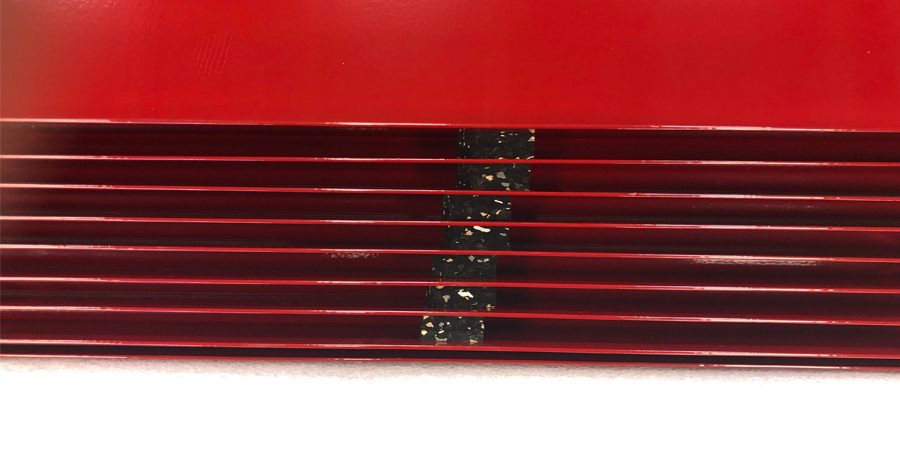
Frank Lowe worked with an agricultural equipment manufacturer that had been using large rolls of wrapping foam between red powder-coated panels. The process was labor-intensive, and the foam they were using was reacting with the powder-coated surface.
Replacing the wrapping foam with custom NeoRebond WOW Pads eliminated both problems.
Temporary protective film can be an excellent choice when the actual surface of a powder-coated product needs continuous coverage.
Frank Lowe’s Clear Advantage Protective Film can protect finished surfaces against scratches, scuffs, dirt, and handling damage throughout manufacturing, transportation, storage, and installation.
Protective film and protective spacer pads solve different problems.
If an exposed finished surface needs to remain covered, protective film may be appropriate.
If stacked components need to be separated and protected at contact points, protective pads may provide a more efficient solution.
WOW Pads are custom die-cut protective pads designed to provide targeted protection between finished products.
Instead of wrapping an entire component or placing large sheets of material between parts, pads can be positioned precisely where separation and cushioning are required.
This can help manufacturers:
WOW Pads can also be produced in custom sizes and thicknesses based on the specific application.
That means the protection is designed around the product rather than forcing the product into a one-size-fits-all packaging solution.
One of the most important considerations when protecting powder-coated products is whether the protective material is compatible with the finished surface.
A material intended to protect a product shouldn’t create a new quality problem.
Manufacturers should evaluate factors such as:
Testing the protective material with the actual finished product is one of the best ways to determine whether it is appropriate for the application.
The best protective material isn’t necessarily the one that covers the most surface area.
It’s the one that provides the right amount of protection in the right places.
For example, if four small contact points are responsible for keeping two powder-coated components separated, completely wrapping each component in bubble wrap or foam may be unnecessary.
A custom protective pad at each contact point can provide separation while significantly simplifying the process.
Over hundreds or thousands of products, that difference can translate into:
There isn’t one protective material that’s right for every powder-coated product.
Protective film may be best when a large finished surface needs continuous coverage.
Foam or bubble wrap may make sense when a product requires full cushioning or wrapping.
WOW Pads are particularly effective when powder-coated products are being stacked, stored, or transported and need reliable separation at specific contact points.
The important thing is to match the protective material to the actual cause of potential damage.
Your powder-coated products have already gone through the work required to achieve a quality finished surface. Your packaging process should help ensure they stay that way.
Frank Lowe works directly with manufacturers to develop custom WOW Pad solutions based on their products, finishes, stacking methods, and handling requirements.
We’ll help determine the appropriate material, size, and thickness for your application, and free samples are available so you can test WOW Pads on your actual products before making a decision.
If scratches, scuffs, or surface damage are creating rejects or rework in your operation, contact Frank Lowe today and let us help you find a better way to protect your powder-coated products.
Since 2002, Randy Cohen has served as the Senior Vice President of Frank Lowe — leading Sales and Marketing as well as a variety of Administrative operations. Randy has 25 years of experience with a background in sales & marketing, production and business management, serving both government agencies and private industry. He holds a B.A from Syracuse University and a Masters and Professional Diploma from Fordham University. Randy uses his unique set of experiences to partner with businesses and entities across all sectors explore, pursue, and create better solutions.