
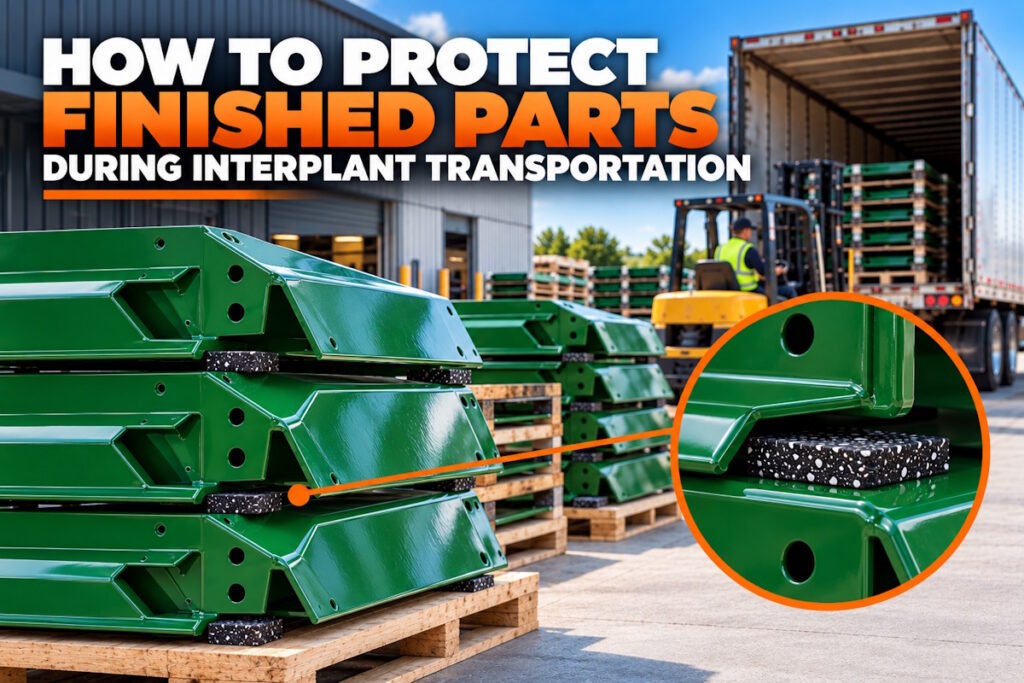
For large Original Equipment Manufacturers (OEMs), manufacturing rarely happens in one location. Components are often fabricated, painted, powder-coated, assembled, and finished at different facilities before being transported to a central assembly plant.
While this approach improves production specialization and efficiency, it introduces an important challenge: How do you protect finished parts during interplant transportation?
The answer starts with using protective packaging materials that prevent surface-to-surface contact, minimize movement, and maintain consistent separation between components during loading, shipping, unloading, and temporary storage.
For manufacturers transporting powder-coated panels, painted metal components, aluminum extrusions, and other finished parts, WOW Pads from Frank Lowe offer a practical solution for protecting components as they move between manufacturing facilities.
Interplant transportation refers to moving materials, parts, or assemblies between different manufacturing facilities within an organization’s production network.
For example, a large agricultural equipment manufacturer might produce tractor hoods at one facility, fenders at another, and chassis components at a third. These components are then transported to a final assembly plant.
Even when parts leave their original manufacturing facility in perfect condition, damage can occur during transportation.
Common causes include:
For high-volume OEM operations, these risks can affect thousands of components moving through the manufacturing supply chain.
A scratched or damaged component doesn’t simply create a packaging problem. It can affect the entire production schedule.
Consider a powder-coated tractor hood that arrives at final assembly with a visible scratch.
The manufacturer may need to remove the component from production, inspect the damage, determine whether refinishing is possible, and potentially arrange for a replacement.
Depending on the severity of the problem, the result could include:
When these problems occur repeatedly across multiple facilities, the total cost can become significant.
Preventing damage during interplant transportation is often far more efficient than repairing it after components arrive.
Not every protective packaging material is appropriate for finished OEM components.
The right solution depends on the component’s size, weight, surface finish, stacking configuration, and transportation conditions.
Cardboard is commonly used between stacked parts because it is inexpensive and readily available.
However, cardboard can absorb moisture, compress under weight, and shift during transportation. It may also create abrasion risks for delicate finished surfaces.
For high-value powder-coated or painted components, cardboard may not provide the consistent spacing required throughout transportation.
Bubble wrap provides cushioning for many lightweight products, but it can be inefficient when protecting large metal components.
Wrapping individual parts requires additional labor, and bubbles may puncture or compress under heavy loads.
Bubble wrap can also occupy considerable space when large quantities of finished components are transported between plants.
Foam sheets can provide effective cushioning, but they may require employees to cut, position, and reposition large pieces of material.
During stacking, loose foam sheets can shift or become difficult to keep in place.
For high-volume OEM operations, this additional handling can slow the packaging process.
Custom protective spacer pads provide targeted protection at the specific points where components need separation.
Rather than wrapping entire products, manufacturers can apply pads directly to designated contact areas.
This approach can simplify packaging while helping maintain consistent spacing and preventing finished surfaces from rubbing together.
Frank Lowe’s WOW Pads are custom die-cut protective pads designed to protect finished components during stacking, storage, handling, and shipping.
For OEM manufacturers moving parts between facilities, they offer several important advantages.
WOW Pads create a protective barrier between finished components.
This helps prevent scratches, scuffs, and abrasions that can occur when painted or powder-coated surfaces come into direct contact.
For manufacturers transporting tractor hoods, equipment panels, metal housings, or fabricated assemblies, maintaining that separation is essential.
One of the challenges of transporting stacked parts is ensuring that protective materials maintain their intended thickness under load.
WOW Pads are available in different materials, sizes, and thicknesses to accommodate specific applications.
For heavier components, Super and Mega WOW Pads provide enhanced compression resistance, helping maintain consistent spacing between stacked products.
Road vibration, braking, and routine handling can cause components to shift.
WOW Pads help reduce movement between contact surfaces while providing cushioning.
Although protective pads do not replace proper load securement, they can complement a well-designed transportation and packaging system.
WOW Pads feature adhesive backing, allowing them to be positioned directly on the component.
Unlike loose sheets of foam or cardboard, the pads remain positioned at designated contact points during normal handling.
This can make the stacking process faster and more consistent for employees preparing shipments between manufacturing facilities.
Traditional packaging methods often involve wrapping entire components or placing large sheets between individual parts.
Custom WOW Pads allow manufacturers to protect specific contact points without covering unnecessary surface areas.
For high-volume interplant shipments, this can reduce packaging material usage, storage requirements, and labor.
WOW Pads are already used in manufacturing applications that demonstrate their potential for interplant transportation.
An agricultural equipment manufacturer was using large foam rolls to protect red powder-coated panels.
The existing packaging process required considerable labor, and the foam was reacting with the finished surface.
By switching to custom NeoRebond WOW Pads, the manufacturer eliminated the material compatibility issue and reduced packaging labor.
This application illustrates how selecting the appropriate protective material can improve both surface protection and packaging efficiency.
A manufacturer shipping weldments to an automotive plant previously used 3/32-inch foam sheets between components.
The sheets were difficult to keep positioned while additional parts were loaded.
Replacing the foam sheets with 3/8-inch-thick NeoRebond WOW Pads simplified stacking and improved the packaging presentation.
At a powder-coating facility, NeoRebond WOW Pads are used to protect 20-foot-long aluminum extrusions during shipping.
The pads provide separation between finished components without requiring bulky foam sheets or cardboard.
Explore More Real-World WOW Pads Applications
For large OEMs, one of the greatest opportunities lies in standardizing how finished components are protected across the manufacturing network.
Consider a manufacturer operating five facilities.
One plant may use cardboard between powder-coated components. Another may use foam sheets. A third may use bubble wrap.
Each facility may have different packaging costs, material handling procedures, and levels of product protection.
Standardizing approved protective packaging materials can help OEMs achieve greater consistency.
Frank Lowe can work with manufacturers to identify protective pad materials, sizes, and configurations suitable for different components.
While not every product requires the same pad, developing approved specifications can support more consistent packaging practices throughout an OEM’s operations.
Protective materials are only one part of an effective interplant transportation strategy.
OEM manufacturers should also evaluate how components are handled, stacked, and secured.
Determine where components are most likely to touch during stacking or movement.
Protective pads should be positioned at these locations to maintain separation and prevent surface damage.
Heavy components can place considerable pressure on lower layers.
Choose protective materials with appropriate compression resistance for the expected load.
Painted, powder-coated, and other finished surfaces can respond differently to packaging materials.
Test protective pads against the actual finish under representative storage and transportation conditions.
Document pad placement, stacking patterns, component orientation, and load securement requirements.
Consistent procedures help reduce variation between employees, departments, and facilities.
Review how components move from the production line to staging, loading, transportation, unloading, and final assembly.
A protective packaging solution should work throughout that process, not just during the truck journey.
For large OEM manufacturers, protective packaging should be evaluated based on total cost rather than material price alone.
Consider the costs associated with:
A packaging material that costs slightly more per unit may still deliver significant overall savings if it reduces labor and prevents damage.
Similarly, replacing large sheets of foam or cardboard with smaller custom pads may improve efficiency across thousands of components.
When multiplied across multiple production lines, facilities, and shipments, even modest improvements in packaging efficiency can produce meaningful operational benefits.
For large OEM manufacturers, moving finished components between facilities is an essential part of the production process.
But every transfer introduces opportunities for scratches, scuffs, shifting, and damage.
Frank Lowe helps manufacturers address these challenges with custom WOW Pad solutions designed around their specific products, finishes, weights, and handling requirements.
Whether you’re transporting powder-coated tractor panels, automotive components, aluminum extrusions, fabricated metal assemblies, or other finished products, our team can help identify the appropriate protective material, size, and thickness.
Operating multiple manufacturing facilities? Let’s explore how WOW Pads can help protect your components, improve packaging consistency, and reduce unnecessary material handling costs across your operation.
Contact Frank Lowe Today to Discuss Your Interplant Transportation Protection Needs
Since 2002, Randy Cohen has served as the Senior Vice President of Frank Lowe — leading Sales and Marketing as well as a variety of Administrative operations. Randy has 25 years of experience with a background in sales & marketing, production and business management, serving both government agencies and private industry. He holds a B.A from Syracuse University and a Masters and Professional Diploma from Fordham University. Randy uses his unique set of experiences to partner with businesses and entities across all sectors explore, pursue, and create better solutions.